What goes into installing an industrial digital press?
Large industrial presses do not arrive ready to switch on. Successful installation depends on planning, logistics, lifting, assembly, utilities, commissioning and coordination between multiple teams.
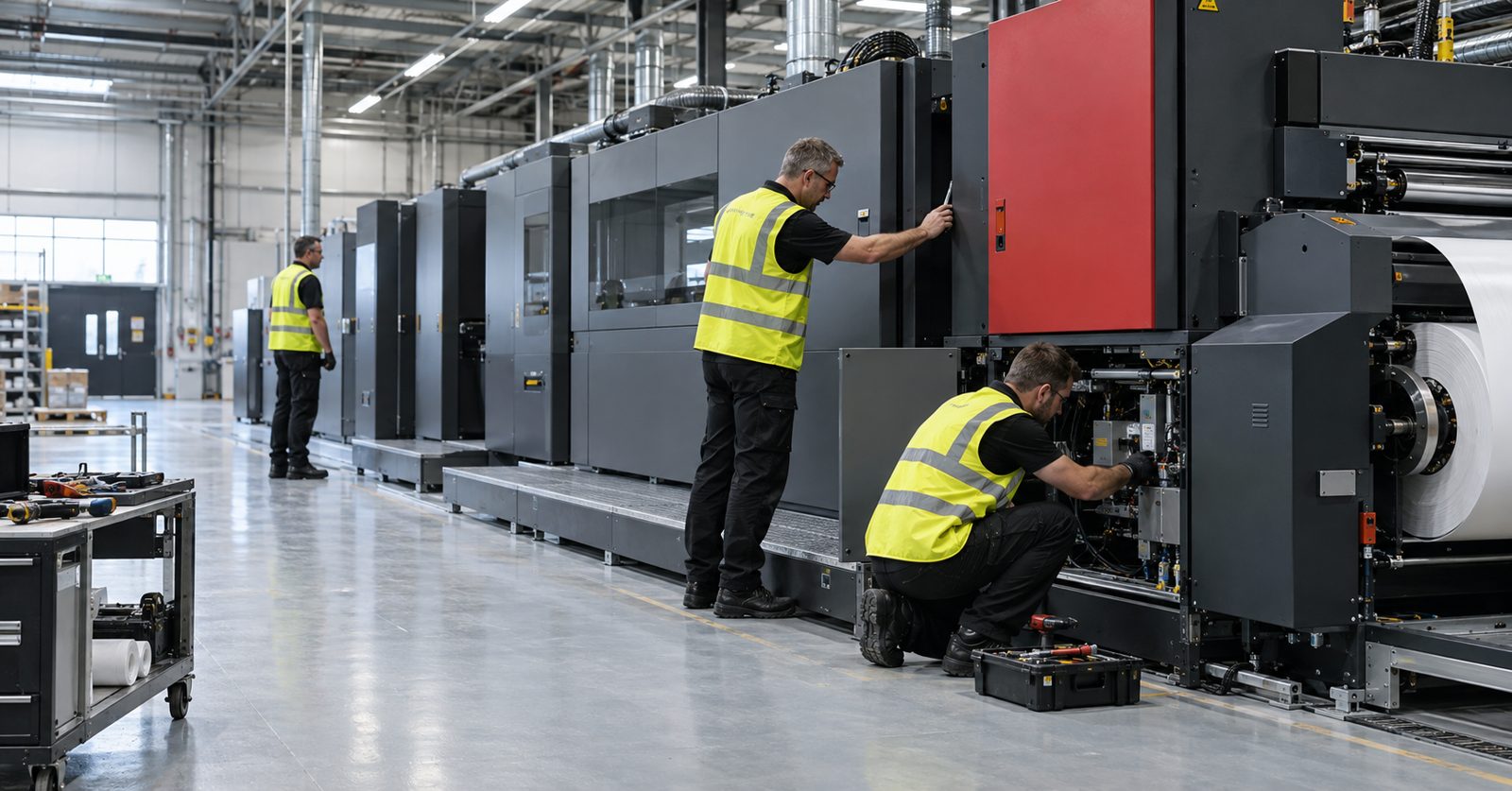
An industrial digital press can fill a substantial part of a production hall. Before it prints its first job, hundreds of individual tasks must be completed in the correct order.
The work starts well before the equipment reaches site.
Preparing the building
Machine drawings and site information must be reviewed against the actual production environment. Access routes, doorways, floor loading, working clearances, lifting points and temporary storage all need to be confirmed.
Power, compressed air, extraction, network connections and environmental requirements must also be ready at the correct stage. A missing service can delay several teams, not just the engineer waiting to connect it.
Moving and assembling the equipment
Large systems often arrive as multiple sections. Each part must be unloaded, moved through the building and positioned without damaging either the equipment or the customer’s premises.
Mechanical assembly is only part of the task. Sections must be levelled and aligned, guarding fitted, cables and services connected and interfaces checked. Feed and delivery equipment, inspection systems and workflow components may involve separate manufacturers or contractors.
Good coordination is therefore as important as technical ability.
Commissioning the complete line
Once the hardware is assembled, engineers work through power-up, safety checks, calibration and functional testing. Individual components may operate correctly on their own while still requiring adjustment to work reliably as one production system.
The final stages include production testing, documentation, customer handover and operator or engineering training.
Engineering capacity that can travel
EFI continues to develop industrial inkjet systems for high-volume display, packaging and textile production. The scale and complexity of this equipment illustrates why manufacturers need engineering resource that can be deployed around the world, often for several weeks at a time.
Dennison provides installation and project engineering for industrial print manufacturers and their customers. Teams can be built around the equipment, location and programme, covering site preparation through to commissioning and handover.
When Dennison represents a manufacturer, that manufacturer’s customer remains its customer. Our role is to provide the engineering capacity needed to deliver the project properly.
Discuss an installation project
Source: EFI newsroom